

Article from:
The lure of jigging
Steve Cooper | March 30, 2011
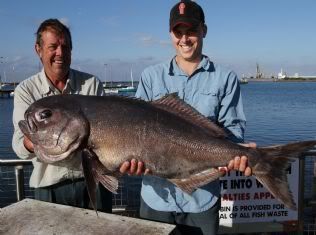
LAST week Portland angler Bob McPherson sent me a photograph of the biggest blue-eye trevalla I have seen - a 23.7kg whopper caught on squid by Terry and Graham Weldon.
The fish wasn't caught on a lure, but might well have been had the anglers been dropping jigs in deep water.
A few years back it looked as though jigging was back on the angler popularity list, but the resurgence didn't last.
Jigging is about dropping a lure to the seabed and retrieving it.
Sounds dull, however, dropping a lure in deep water offshore exposes anglers to a host of new and colourful fish.
Tackle requirements are minimal but the physical demands can be overpowering and a strong back and arms are required, as is a sound heart.
Some species require a fast retrieve, others will strike the lure on the drop and so on.
The variation on the method used depends on what is working on the day.
Some of my best jigging experiences have been in southern waters with species that include nannygai (red snapper), groper, snapper, and Samson fish.
On the east coast, there have been encounters with fish like estuary cod, coral trout, jobfish, amberjack, giant trevally and yellowtail kingfish.
In northern waters, black mulloway take the prize as my favourite species.
Moreover, just because you are dropping lures to the bottom doesn't mean you won't catch midwater or even surface species.
Many times, I have seen or experienced a strike as the lure comes through the different species' feeding zones.
In the Arafura Sea, off Darwin, you might be jigging for mulloway and during the retrieve come up fast into a speeding mackerel that takes off like a freight train.
In Queensland and NSW, yellowtail kingfish and amberjack can follow and take lures, and in Victoria and South Australia, barracouta can provide a constant interruption.
When you jig, you never know what you will catch.
I recall fishing a small seamount near Kangaroo Island, which rises from about 85m of water to within 40m of the surface and features a ledge along the northern side and a gradual slope at the southern edge.
We drifted over that rock for a few hours using 200g lures.
These were dropped to the bottom and then retrieved fast, with either a lift and wind action or a straight wind.
The results were blue groper to 20kg, blue morwong to 3kg, nannygai to 4kg and Samson fish to about 35kg.
We would have caught bigger Samsons; trouble was they were too tough.
When you find a likely looking reef or seamount and decide to jig, first calculate direction and speed of drift, otherwise you might drift the wrong way or drift too fast.
Drift direction involves positioning the boat to suit wind and tide.
When you get the position right, set a waypoint on your GPS system and work from there.
If the drift rate is too fast, slow it down by putting out a sea anchor.
If you are after serious fish my advice is not to jig with any outfit less than 15kg; most anglers work 24kg outfits.
A heavy-duty outfit is necessary, but you won't need a second mortgage to pay for it.
Many middle-of-the-road reels will adequately handle most fish you are likely to hook.
Look closely at the tackle, feel the reel, and make a decision based on the recommendations of people outside the trade and not pushing product.
Jig rods are also purpose built.
Most are 1.6m to 1.85m long and constructed from hi-density graphite and feature hardwearing guides made from space age heat resistant materials.
Shop around before buying as I have seen 15kg snapper rods work well enough to suggest you don't need a $500-plus purpose-built rod.
Current flow can be a problem in deep water and line drag in the water is a problem with monofilament.
The alternative is to use braid, which is about one-third the thickness of the same breaking strain in monofilament and there is no line stretch, which is an advantage because strikes are felt instantly through the line.